In Thailand, you stroll leisurely through the clubhouse, hop on a cart, and the round flows naturally under the caddie's guidance. Japan has a quite different feel — everything runs on the clock. Tee-off times are kept to the minute, pace of play is about "not falling behind the group ahead," and after the front 9 you eat lunch and start the back 9 at a designated time. Once you understand this "on-time culture," a Japanese golf course is wonderfully smooth and free of friction.
The big picture of a Japanese round — the rhythm of the day
A regular round in Japan goes front 9 → lunch (half turn) → back 9, an itinerary that, with lunch, takes up nearly the whole day. Sketch it out on a timeline in advance and nothing will catch you off guard.
- Arrival — 1 hour before start recommendedAllow plenty of time for front-desk check-in, changing clothes, the practice green, and so on. Arrive no later than 30 minutes before your start.
- Reception · paymentAfter confirming your reservation at the front desk, you receive your locker key. Payment is usually after the round, but it varies by course.
- 10 minutes before start — gather at the start houseIn Japan, punctual start times are an ironclad rule. Take the cart to the start house and arrive to wait at least 10 minutes before your start.
- Front 9 — target 2 hours 15 minutesStart intervals are tight, at 7–10 minutes. Keep a pace of about 2 hours 15 minutes per 9 holes, always conscious of your gap to the group ahead.
- Half turn — clubhouse lunchAfter the front 9, have lunch at the clubhouse restaurant (usually 45 minutes to 1 hour). Japanese courses build the meal into the schedule.
- Back 9 start — depart at the "designated time"Important! Your back-9 start time is designated right there when the front 9 ends (e.g., "back 9 starts at 12:40"). After lunch, head to the back-9 tee in time for that slot.
- Back 9 — another 2 hours 15 minutesFinish at the same pace. All 18 holes, including lunch, typically take about 5 to 5.5 hours.
- End of round — settle up · bathe · head homeMost clubhouses have a bathhouse (ofuro/onsen). After settling up, wash off and finish refreshed.
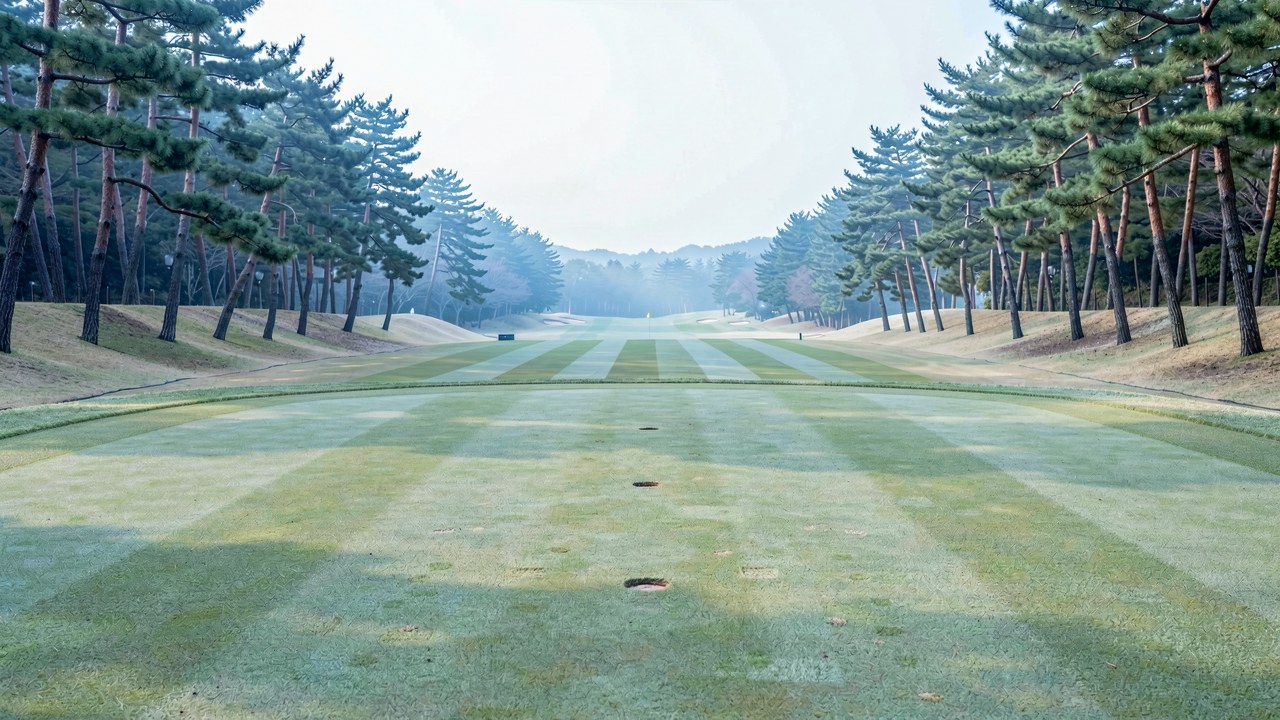
① Start house check-in — the last gateway to the first hole
This is the most unfamiliar part of the flow at a Japanese course. Finishing reception at the clubhouse front desk does not mean you head straight to the 1st hole. After reception → changing clothes → boarding the cart, you take the cart to the start house (スタートハウス, sutāto hausu) at the entrance to the course. There, a staff member confirms your group number, tee-off time, and players once more, then gives the signal to start. Think of it as the "boarding gate" at an airport and it's easy to grasp.
- Reception at the clubhouse front deskGive the name on the reservation and receive your locker key and reception card (scorecard holder). Up to this point is covered in the previous chapter, "Golf course arrival · check-in."
- Change clothes in the locker roomChange into your golf attire and put on golf shoes. Leave valuables in the locker and take only what you'll use for the round (gloves, sunscreen, phone).
- Board the cart at the cart platformGo to the cart platform in front of the master's room. Your golf bag is already loaded on the cart. Once you board, the cart moves to the start house automatically or per guidance.
- Arrive at and wait at the start houseIt's a small building at the course entrance. Arrive to wait at least 10 minutes before your start. Restrooms and a drink vending machine are usually here.
- Staff confirm your group number and tee-off timeThe starter calls out and confirms, "Mr./Ms. ◯◯'s group, starting at ◯:◯◯." Just show your reception card or the group number on the cart navi. For self-play, they'll go over how to use the cart navi again here.
- Tee off on the 1st hole (or designated hole)Hit your first tee shot on the staff member's signal of "dōzo (どうぞ, please go ahead)." Now the round begins.
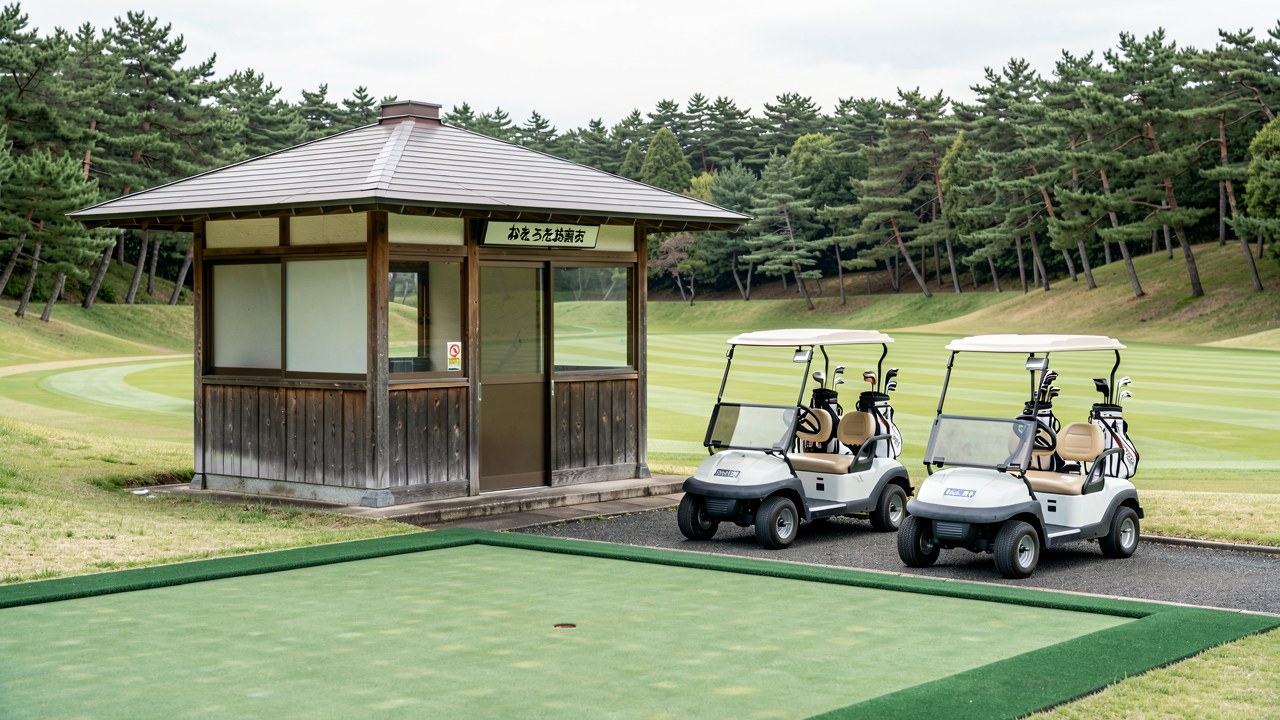
① "10 minutes before start" means the time you arrive at the start house, not the clubhouse. Factor in the cart ride from the clubhouse and move even earlier.
② Take your last restroom break and refill water at the start house. It's hard to stop again during the front 9.
③ Your group number is on the cart navi screen or your reception card. Just show it when the staff ask.
② Clubhouse map and the route on round day
The most confusing thing at a course you're visiting for the first time is "where do I go?" Here's an at-a-glance summary of the zone layout of a Japanese clubhouse and the order you move in on round day. The gold arrows are your route for the day.
Before the round — the way in
- Entrance · front deskUnload your golf bag from the car, check in under the reservation name, receive your locker key
- ↓
- Locker roomChange into golf attire, store valuables, put on golf shoes
- ↓
- (If needed) RestaurantIf you arrive early, a light meal or drink. Usually skipped
- ↓
- Pro shopBuy gloves, balls, consumables; a last check before heading to the practice green
- ↓
- Start houseAfter boarding the cart and moving, staff confirm your group number and tee-off time
- ↓
- Course (1st hole)Hit your first tee shot on the start signal — the round begins
- Course (18th hole)Finish play, return to the clubhouse by cart
- ↓
- Locker roomPut away golf shoes, gather your bathing things
- ↓
- Large communal bath · onsen (ofuro)The highlight of a Japanese golf course. Wash off the sweat and finish refreshed
- ↓
- Payment · front deskSettle the restaurant and shop charges put on your locker key number all at once, then head home
On the way in: front desk → locker → (restaurant) → pro shop → start house → course; on the way out: course → locker → communal bath → settle up. The most confusing points are that "after the front desk comes the start house, not the 1st hole directly," and that "settling up is the very last step at the front desk."
③ Keep your start time "to the minute"
Japanese courses send groups off at 7–10 minute intervals. Since even one late group throws off the whole day's schedule, they take punctual start times very seriously. The standard is to arrive and wait at the start house 10 minutes before your start. Even if you're spending time on the practice green, never forget your start time.
In Thailand a caddie looks after you and there's flexibility, but in Japan 5 minutes late affects every group behind you. If you're late, your start may be pushed back in the order, or you may have to skip a hole. Check both your watch and the time on the cart navi.
④ Pace of play — "keep up with the group ahead"
The standard for pace in Japanese golf is simple: "Don't open up a gap to the group ahead." The key is to gauge yourself against the group ahead, not the group behind. If the group ahead is a full hole clear and you can't keep up, you become the "slow group."
- While moving to the teeing ground or green, prepare your next shot in advance (carry 2–3 clubs, check the distance beforehand).
- The time to look for a ball is set at within 3 minutes. If you can't find it, move on without regret using a provisional ball or a drop.
- Putting goes faster if "everyone gets on the green and prepares at the same time." Divide up flagstick duties in advance, too.
- Record and tidy up scores while moving to the next tee, or in the cart (don't linger on the green).
Rather than the strict "farthest player first" order, ready golf — whoever is prepared hits first — helps pace. As long as safety is assured, don't fuss over order; let whoever is ready proceed quickly. That said, lightly honoring the tee-shot order (the honor) looks good.
⑤ Half turn — lunch and the "designated back-9 time"
The most unfamiliar part of a Japanese round is the half turn (ハーフターン, hāfu tān). After finishing the front 9, you don't go straight to the back 9 — you return to the clubhouse and eat lunch. And the back 9 doesn't start whenever you like; you depart at the designated back-9 start time that staff tell you when the front 9 ends.
Lunch is part of the schedule
Usually 45 minutes to 1 hour. Enjoy clubhouse menu items like rice dishes, udon, and curry. Even if you're not hungry, use it as a rest break.
Be sure to remember the back-9 time
It's designated, like "back 9 at 12:40." Don't get so absorbed in lunch that you miss it — confirm it once more with your group.
Some courses and plans run as through play (スループレー, surū purē), going through 18 holes without a lunch break. It takes less time. Confirm in advance whether your reservation is regular (with a half-turn lunch) or through play, and planning your day is easier.
⑥ Shot safety and "Fore!"
If there's any risk that your shot will fly toward another person, immediately shout "Fore! (フォー!)" loudly. Never hit while the group ahead is within range. Japanese courses place great importance on safety and orderly pace, so slow play, disputes, and retaliatory behavior are off-limits.
The moment you hit thinking "it won't reach them," it becomes a serious accident. Wait until the group ahead has completely cleared the green or fairway. Even if a slow group ahead is frustrating, hitting to hurry them along or arguing is prohibited. If you're truly frustrated, politely inform a marshal.
⑦ Markers · scoring and partner etiquette
In self-play, you keep your own score, but your group shares the marker role of confirming each other's strokes. Enter it on the cart navi or write it on the scorecard, then when the hole ends, casually check "how many on this hole?" and there'll be no disputes.
- When someone is addressing the ball or swinging, be quiet and don't move.
- On the green, don't step on putting lines (a stepped-on mark affects the putt).
- Refrain from phone calls and loud talk; keep cart music moderate out of consideration for your partners and surroundings.
- A word at the start and end of the round — "yoroshiku onegai shimasu / arigatō gozaimashita" — keeps the mood pleasant.
How the start house operates, the start intervals, the half-turn lunch time, how the back 9 is designated, and whether it's through play all vary by course and reservation plan. Follow Fukuoka Century Golf Club's same-day guidance (front desk, start house, cart notices) as your reference.