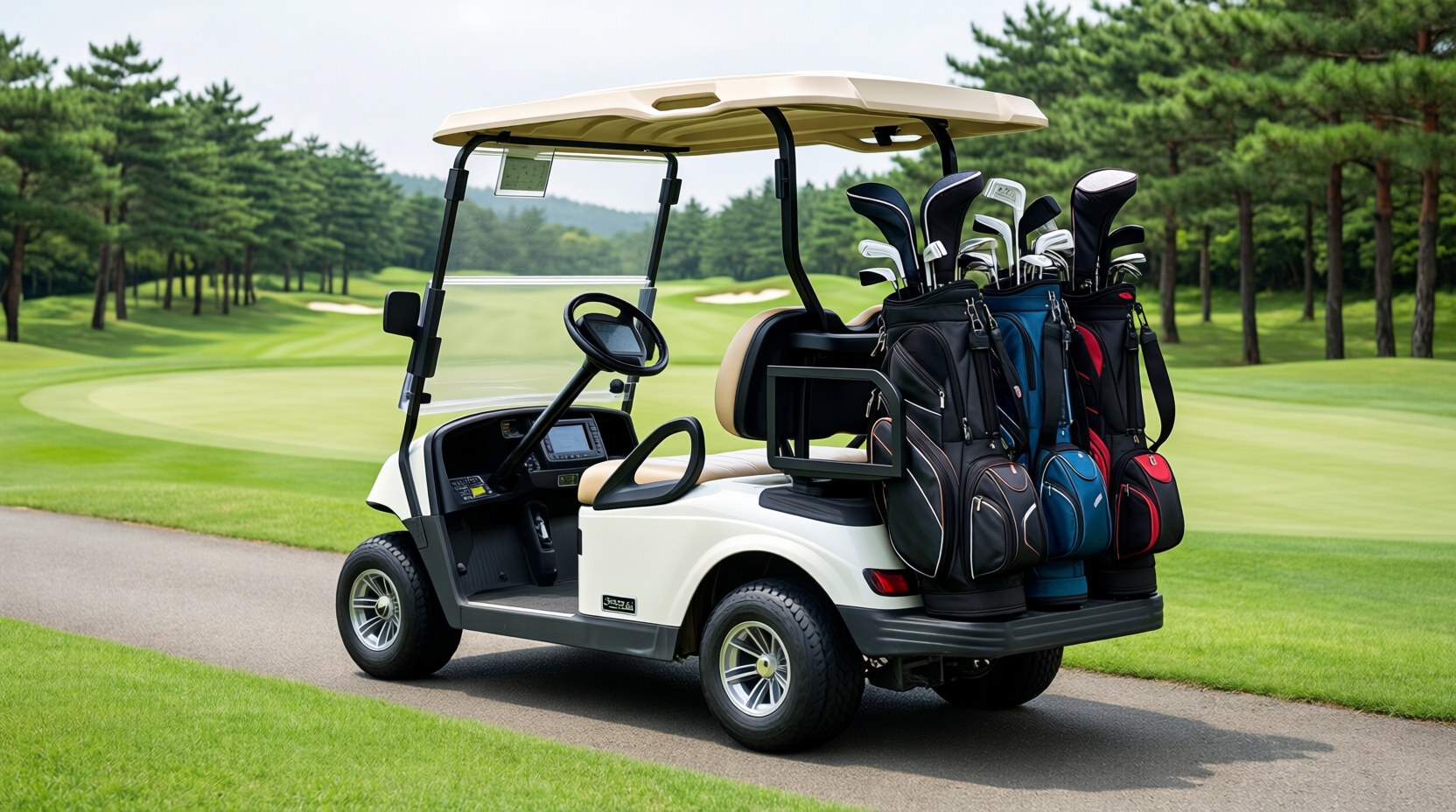
Carts at Japanese golf courses are quite different from the ones you rode in Thailand. They're automatic carts that follow the path on their own without a steering wheel, fitted with GPS navigation that shows distances and the green on a touchscreen. At first you might think, "How on earth do I drive this?" — but once you understand the principle, it's actually easier. Let's learn the basics of autonomous driving, remote control operation, and cart-path rules one at a time.
First things first — the "electromagnetic-guided" automatic cart
The majority of carts at Japanese golf courses are electromagnetic-guided (電磁誘導式). The cart detects the magnetic field of a guide wire buried under the cart path and follows the set route on its own. There's no need to turn a steering wheel. The driver only operates start and stop.
| Drive system | Electromagnetic-guided autonomous driving — follows a guide wire buried in the cart path along a fixed route |
|---|---|
| Controls | The cart's start/stop buttons + a handheld remote control |
| Steering wheel | None (autonomous), or rarely used on the cart path even if present |
| GPS navi | The touchscreen at the front of the cart shows the hole layout, remaining distance, green shape, and elevation |
| Capacity | Usually 4-seater (4 players + 4 golf bags) |
Step 1 — Reading the GPS navigation screen
The color screen at the front of the cart is your most reliable companion throughout the round. Even in caddie-free self-play, thanks to this screen you won't get lost even on a course you're visiting for the first time.
Hole layout
Shows the whole shape of the hole you're playing (fairway, bunkers, hazards, green position) as a map seen from above.
Remaining distance
Displays in real time the yards (or meters) from your current cart position to the front, center, and back of the green.
Green shape · elevation
You can zoom in on the green's shape and pin position, plus slope and elevation, which helps with club selection.
Pace · group ahead
Some screens even show your gap to the group ahead, your pace of play, and restaurant orders (pre-ordering lunch).
Step 2 — Autonomous driving and remote control
Rather than "driving" the cart, think of it as signaling start and stop. The cart follows the path by itself.
- The cart stops at the shot pointThe cart automatically stops at a fixed stopping point on the cart path. Get out, grab your club, and head to your ball.
- Send the cart ahead with the remoteIt's fine if the cart stays behind while you focus on your play. Press the button on the handheld remote control and the cart moves on its own to the next stopping point. The button is usually simple — just a single "go/stop."
- Start and stop with the cart's own buttonsIf there's no remote, the person riding the cart presses the "発進 (start)" button on the cart itself. Press it and the cart follows the guide wire to the next point and stops automatically.
- Get out near the green to finishWhen the cart stops at the stopping point in front of the green, grab your putter and head onto the green. The cart waits, ready to move on to the next hole.
When your ball is far from the cart path, instead of dragging the cart along, just send the cart ahead with the remote and walk over with a few clubs. Once you've hit, hop into the cart waiting up ahead — your pace of play is much faster.
Step 3 — Cart-path-only driving vs. fairway entry
This is the most confusing part. Japanese golf courses fall broadly into two types.
Cart-path only (most courses)
The cart travels only on the paved cart path. It never goes onto the grass (fairway). Electromagnetic-guided automatic carts fall into this category.
Fairway entry allowed (some courses)
Only courses with a "乗り入れ可 (noriire ka, entry allowed)" sign permit driving on the grass. In this case the cart is often a self-driven (自走式) type with a steering wheel.
Unless there's a sign, the cart must not leave the cart path. It's a rule to protect the turf, and you'll be stopped if you break it. If there's no "乗り入れ可" notice or staff explanation, assume it's cart-path only. After rain, even fairway-entry courses sometimes switch to "cart-path only" just for that day.
Step 4 — Riding and safety etiquette
Even an automatic cart is a machine that moves with people aboard. Follow a few rules and you can enjoy it safely and with good manners.
- While the cart is moving, always stay seated and hold the grab handle (don't stand or stick your feet out)
- Don't exceed the capacity (usually 4) — no hanging on
- Before starting, check that everyone is aboard and no clubs have been left behind
- Even an automatic cart sways on downhills and curves — hold the grab handle firmly
- No driving (self-driven type) after drinking — many courses also prohibit lending carts to unlicensed drivers
- Get on and off only after the cart has come to a complete stop at the stopping point
Japanese golf courses manage pace strictly. The cart screen shows your gap to the group ahead, so if you fall behind, send the cart ahead in advance and catch up quickly. A brisk pace is consideration for the group behind and a basic courtesy of Japanese golf.
The cart type (electromagnetic-guided · self-driven), whether fairway entry is allowed, and whether a remote is provided vary by course and by that day's course conditions. The safest approach is to confirm the controls with the front desk or starter before teeing off on the first hole.