Japan is a country where English doesn't get you very far. But don't worry — a single short phrase in Japanese changes the whole mood. The expressions in this chapter are all ones you'll actually use on a golf trip. No need to memorize them. Press the 🔊 button and it plays the phrase for you, so when the moment comes, just open it up and play it, or repeat after it.
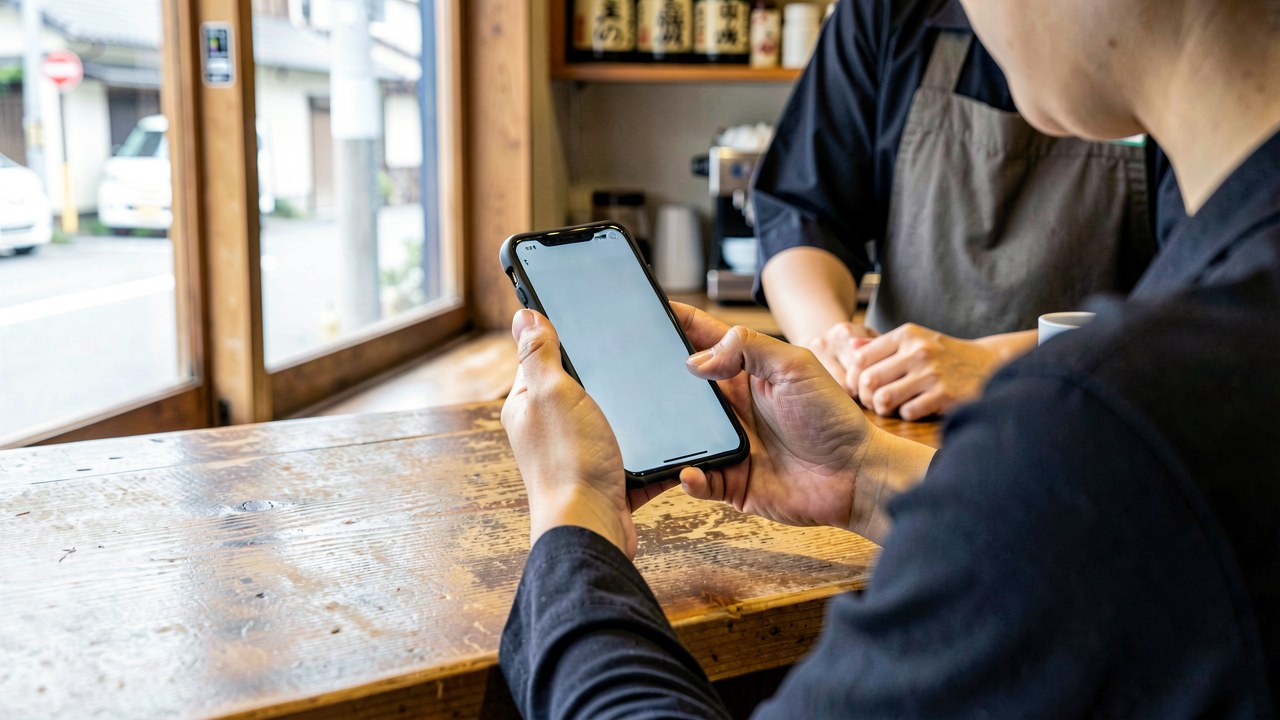
Press the 🔊 button to the right of an expression and it plays the Japanese out loud. If it's hard to repeat, show the screen to the other person or press the button to play it for them. In the printed version the buttons aren't visible, so just read the romaji as written.
1. Basics — greetings, thanks, apologies
These five phrases smooth out 90% of a trip to Japan. In particular, sumimasen is an all-purpose expression that covers "excuse me / sorry / over here" all at once.
2. Restaurant — ordering, recommendations, paying
At a Japanese restaurant, to call over a staff member from your seat, just say "sumimasen." Point at the menu and use the expressions below to finish your order.
You don't need to tip anywhere — restaurants, taxis, or golf courses. Just pay the amount on the bill as is. If you leave the change behind as a "tip," the staff will actually chase after you to return it.
3. Shopping · convenience stores
The questions you'll hear most at convenience stores (konbini) and drugstores are "Would you like a bag?" and "Shall I heat it up?" Knowing the answers in advance keeps you from getting flustered.
4. Asking directions · transport
Even with a smartphone map, there are times it's hard to find an exit or boarding platform. Show the screen to a station attendant or passerby and use the expressions below.
5. Golf course — reception, start, asking for help
This is the main stage of this trip. A Japanese golf course proceeds in the order of reception (check-in) → locker → starting hole. Here are the expressions to use with staff, caddies, and your playing partners.
Most Japanese golf courses settle everything at once at the front desk after the round. Just say "Okaikei o onegai shimasu — the check, please." Card payment is almost always possible, but at some places the caddie gratuity is cash, so keep a little cash on hand.
6. Numbers · time · amounts
Just being able to catch the numbers is a big help when hearing a price or setting a time. Showing it with your fingers at the same time makes it even clearer.
| 1 / 2 / 3 | ichi / ni / san |
|---|---|
| 4 / 5 / 6 | yon (shi) / go / roku |
| 7 / 8 / 9 / 10 | nana (shichi) / hachi / kyū / jū |
| 100 / 1,000 / 10,000 | hyaku / sen / man (e.g., 5,000 yen = go-sen en) |
| today / tomorrow / day after tomorrow | kyō / ashita / asatte |
| what time / ~ o'clock / ~ minutes | nan-ji / ~ji / ~fun (pun) |
7. When you're stuck — slowly · do you speak English? · this one, please
These are the "rescue expressions" to use when speech is too fast or you can't catch it. With just these three, you can get through any situation.
For longer conversations these cards can't handle, use the voice-translation feature of Google Translate or VoiceTra (a free interpretation/translation app supported by the Japanese government). Download it in advance and alternate it with these voice cards to get through almost any situation.
The romaji is an approximation written to be easy to read. For accurate pronunciation, listen with the 🔊 button on each expression. A long vowel (macron) means lengthening the preceding vowel.