Vietnam's currency is the dong (VND), with a lot of zeros that confuse newcomers. Remember one thing: Thai baht is not accepted as payment in Vietnam. You must exchange it to dong.
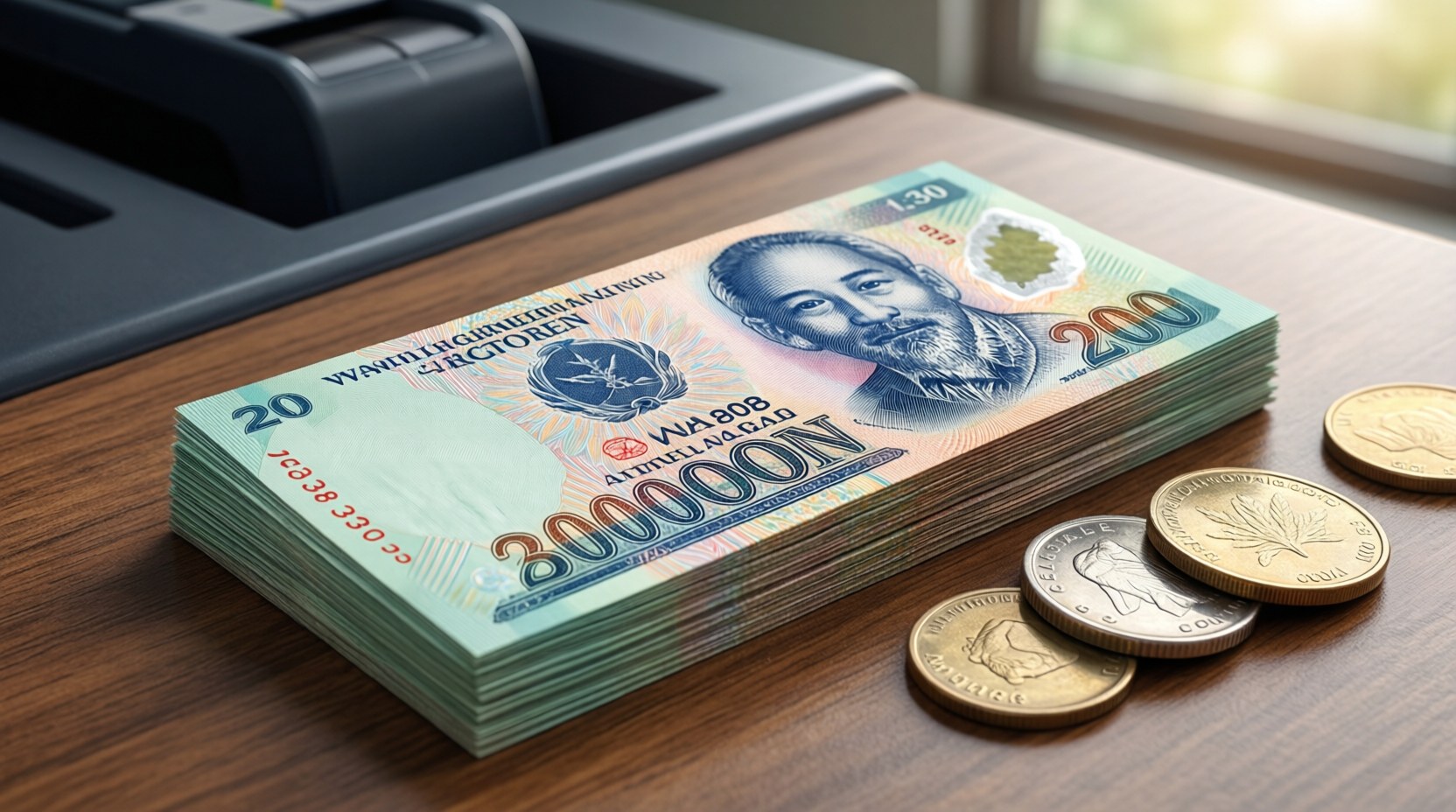
Getting a feel for the dong
Roughly 1 THB ≈ 800 VND (so 100 THB ≈ 80,000 VND) makes on-the-spot maths easy. Rates move, so treat this as an approximation. Common notes are 10,000 · 20,000 · 50,000 · 100,000 · 200,000 · 500,000 dong.
Counting zeros: drop the last three zeros and multiply by 0.8 for a rough baht figure. E.g. 200,000 VND → 200 × 0.8 ≈ 160 THB.
| Currency | Vietnamese dong (VND, ₫) |
|---|---|
| Approx. rate | 1 THB ≈ 800 VND (volatile) |
| Pay in baht directly | Not possible — exchange to dong |
| ATM withdrawal fee | ~22,000–55,000 VND per withdrawal |
| Card payment | Hotels, clubhouses, upscale venues |
Where to exchange
For baht-to-dong, banks, licensed money changers and gold shops (downtown 'Tiem Vang') usually give the best rates. Airport counters are poorer, so change only a little at the airport for the taxi and a SIM, and exchange the rest in town. Big hotel desks also change money but at lower rates than banks.
ATMs are widespread. Most charge 30,000–55,000 dong per withdrawal, and low-cap machines dispense only 2,000,000–3,000,000 dong at a time. Travellers rate VPBank ATMs highly — no fee for foreign cards and a high per-withdrawal limit (up to 10 million dong); MB Bank also allows fee-free withdrawals. To save on fees, withdraw the maximum at a higher-limit bank ATM. On screen, always choose 'local currency (VND)' (the baht-conversion option gives a poor rate). Carry two cards from different issuers and store them separately in case of loss.
Cash exchange
Banks, licensed changers and gold shops give good rates; the airport only for small amounts. Cash is essential for caddie tips, street stalls and smaller towns.
ATM withdrawal
Widespread and 24h. There's a per-transaction fee (~22,000–55,000 dong) so withdraw up to the limit at once. Tell your bank about overseas use before you go.
Card payment
Visa/Mastercard work at hotels, clubhouses, upscale restaurants and large stores. Not for small purchases, stalls or caddie tips. If offered DCC (billing in baht), choose 'local currency (VND)'.
Mobile pay
Locals use QR wallets (MoMo, ZaloPay), but sign-up is awkward for foreigners. For travellers, a cash-plus-card combination is the simplest.
At Vietnamese courses a caddie is mandatory — self-play is essentially not allowed, and each group is assigned caddies. The caddie tip is paid in cash after the round by custom, usually 200,000–500,000 dong per caddie (about 250–600 baht), adjusted for service. Prepare several 100k/200k notes before the round. Small cash is also handy for cart/restaurant tips and street snacks.
Tipping norms
Tipping is not compulsory in Vietnam, but a caddie tip is effectively expected at golf courses. Otherwise, use these as a guide:
- Restaurants: if a 5–10% service charge is included, no extra tip needed; otherwise round up
- Hotel bellboy/housekeeping: 20,000–50,000 dong
- Spa/massage: 50,000–100,000 dong is common
- Grab driver: rounding up the change is plenty
Connectivity — SIM and eSIM
You want data the moment you land so Grab, maps and translation work. The three main carriers are Viettel (best coverage), Mobifone and Vinaphone. Buy a tourist SIM (from ~50,000 dong + a data package) at the airport, city shops or convenience stores; staff will activate and set it up. On a newer phone, buy an eSIM before departure so you're connected on arrival. Bring your passport, as registration may be required.
Vietnamese tap water is not safe to drink. Drink bottled water, and use it for brushing teeth and (ideally) ice. Dehydration on a hot round is a real risk, so carry plenty of bottled water on the course and use the water provided in the cart.
"500,000-dong notes often can't be broken at stalls or in taxis — break them into change in advance." "It's easy to hand over the wrong note when colours and sizes look alike, so I always recounted the zeros before paying." "For ATMs I only used VPBank because there's no fee." — get comfortable with small notes and counting zeros, and you're fine.
- At the airport, change only enough for taxi and SIM
- Main exchange at a city bank / gold shop / licensed changer
- Set aside several 100k/200k notes for caddie tips
- Use low-fee ATMs (e.g. VPBank); choose VND on screen
- Split cards and cash; enable overseas card use before you go
- Connect a SIM/eSIM on arrival; keep bottled water
In short: change a little at the airport → main exchange at a city bank/gold shop → set aside small notes for caddie tips → connect a SIM/eSIM on arrival. Follow these four steps and money/connectivity rarely causes trouble.